Without doubt the most popular beer style at the moment is IPA. These heavily hopped golden beers have really caught the imagination, fuelled by the interest in craft beers and use of American and Australian hops. However one other beer style that is also making something of a comeback is the good old fashioned stout or porter!
Now, most brewers bottled beer range is not complete without a beer of this style and its great to see. They are really very different to IPA's and Pale Ale's and have also moved forward from the harsh roast flavour that some stouts have had in the past. It's now common in these beers for chocolate and coffee to be dominant flavours making them sweeter and fuller.
Hook Norton Double Stout is a fine example of this style, a good balance of chocolate and roast and not as sweet as some of the more modern stouts can be. St Austell Brewery's recent addition of 1913 Cornish Stout is step back in time as the name suggests. Well balanced again, it has that touch of liquorish and roast typical of an oatmeal stout that make this a bit more of a savoury drink. Fullers London Porter is a quite superb beer and in my view one of the best beers of this style on the market. Finally, just like a dessert, Meantime Chocolate Porter is the perfect beer to finish the night on.
There was a time when the mere mention of the words stout and porter would be a firm indicator not to buy! However the next time you visit the local supermarket, sidestep the IPA's for once and give one these great beers a try. Don't spend the whole night drinking them, you won't enjoy it, but they do make a superb contrast to your normal beer choice so slipping one of these into your repertoire of an evening will enhance your overall enjoyment of drinking beer.
And to finish, if you did not already know, the difference between a stout and a porter is historically strength (abv%). Porter was traditionally the standard fayre that the London Porters drank and stout was a word used to describe the strongest beers - in fact historically there were even pale stouts brewed, but then that's another story.....
Sunday, 12 May 2013
Monday, 6 May 2013
Importance of Beer Festivals!
One thing I've enjoyed reading over the weekend are the tweets emanating from people attending Reading Beer Festival. This along with conversations I've had this week with the organisers of Plymouth Beer Festival, has reminded me of the vital role these festivals play in showcasing and promoting sales of cask ale.
However, there are problems...beer quality at these events can at best be described as variable. Most regional CAMRA groups - the most common of beer festival organisers don't have the finance or equipment to provide cooling on their beers. Thus although different methods are used to try and keep the beer cool, much is often served at room temperature, particularly as the festival progresses in time.
The more popular the event, the more people and the hotter the room gets and the more beer in each barrel that is drunk, increasing the serving beer temperature a lot quicker. Not great when most brewers and many pubs are stringent in ensuring their beers are served at perfect cellar temperature. So more often than not, the beer festival that is designed to promote the sales of cask ale, ends up serving beer that is too warm, indifferent quality, not that palatable and certainly not what consumers are used to experiencing in pubs.
Financially beer festivals are a risk - beer is expensive and a lot of money has to be invested up front to buy stock. It's easy to get wrong. Have too much and you can lose a lot of money. Have too little and you end up with a lot of unhappy paying customers.
So why do this and why are beer festivals still so popular? For one it's down to passion. The people that organise these events are passionate about beer. They are real ambassadors for the category and live and breath cask ales, working tirelessly to ensure beer festivals are a success.
Another reason is that many consumers see cask ales as British. They want to be patriotic and see a home grown product succeed over and above the larger mass produced lagers, kegs and a certain Irish stout. Many consumers are willing to overlook a slightly warm and unpalatable pint, in-fact it's almost expected and part of the experience - unpleasant as some warm beers can be.
Beer Festivals are also great social occasions where friends can meet, enjoy a drink and swap stories. Beer is a great ice breaker for strangers to converse, the one thing they have in common is a taste for beer so instantly there is something to talk about. Music has also become a key part of some festivals so the event is more of a party.
From the brewers perspective festivals provide a vehicle to show case their brands, launch new beers and reward beers and brewers for excellence. Every brewer wants to win an award at these events, no matter how small the festival or beer category. They are important from this respect giving the smaller brewers in particular a level playing field to compete against the larger more establish regional brewers.
I have spent many a long day at beer festival's, both socialising but mostly working and believe their importance is huge. Every person that goes to a beer festival is a potential ambassador for beer. Brewers should be trying hard to reach these people and interact with festival organisers, who themselves are important opinion formers. Some brewers spend a great of money on marketing and overlook this grass roots form of reaching customers. Perhaps that's to the benefit of the smaller brewers whose only marketing option is to look at events like this - interesting then that the surge and interest in cask and craft beers has come with the growth of smaller brewers!
Good luck to all Beer Festival organisers. I for one am looking forward to my next event at Plymouth.
However, there are problems...beer quality at these events can at best be described as variable. Most regional CAMRA groups - the most common of beer festival organisers don't have the finance or equipment to provide cooling on their beers. Thus although different methods are used to try and keep the beer cool, much is often served at room temperature, particularly as the festival progresses in time.
The more popular the event, the more people and the hotter the room gets and the more beer in each barrel that is drunk, increasing the serving beer temperature a lot quicker. Not great when most brewers and many pubs are stringent in ensuring their beers are served at perfect cellar temperature. So more often than not, the beer festival that is designed to promote the sales of cask ale, ends up serving beer that is too warm, indifferent quality, not that palatable and certainly not what consumers are used to experiencing in pubs.
Financially beer festivals are a risk - beer is expensive and a lot of money has to be invested up front to buy stock. It's easy to get wrong. Have too much and you can lose a lot of money. Have too little and you end up with a lot of unhappy paying customers.
| Barrels at Bristol Beer Festival |
Another reason is that many consumers see cask ales as British. They want to be patriotic and see a home grown product succeed over and above the larger mass produced lagers, kegs and a certain Irish stout. Many consumers are willing to overlook a slightly warm and unpalatable pint, in-fact it's almost expected and part of the experience - unpleasant as some warm beers can be.
Beer Festivals are also great social occasions where friends can meet, enjoy a drink and swap stories. Beer is a great ice breaker for strangers to converse, the one thing they have in common is a taste for beer so instantly there is something to talk about. Music has also become a key part of some festivals so the event is more of a party.
From the brewers perspective festivals provide a vehicle to show case their brands, launch new beers and reward beers and brewers for excellence. Every brewer wants to win an award at these events, no matter how small the festival or beer category. They are important from this respect giving the smaller brewers in particular a level playing field to compete against the larger more establish regional brewers.
I have spent many a long day at beer festival's, both socialising but mostly working and believe their importance is huge. Every person that goes to a beer festival is a potential ambassador for beer. Brewers should be trying hard to reach these people and interact with festival organisers, who themselves are important opinion formers. Some brewers spend a great of money on marketing and overlook this grass roots form of reaching customers. Perhaps that's to the benefit of the smaller brewers whose only marketing option is to look at events like this - interesting then that the surge and interest in cask and craft beers has come with the growth of smaller brewers!
Good luck to all Beer Festival organisers. I for one am looking forward to my next event at Plymouth.
Thursday, 2 May 2013
Beer & BBQ's!
So at last the sun has arrived and suddenly everyone starts thinking about al-fresco dining and the good old English BBQ. Growing up in the 70's and 80's, BBQ's were something only the local pub did as a treat but now every back garden has one.
Instantly BBQ's are associated with a can of Fosters for refreshment, but just like the food we cook has moved on to become more adventurous, our choice of refreshment needs to change as well.
That's not to say there is anything wrong with a refreshing lager on a hot summers evening, but don't limit yourself to that when it comes to the choice of beer. So what beer's go best with a BBQ? Lighter golden beers seem to be the most appropriate as naturally we drink with our eyes so here are a few suggestions of great beers to enjoy. Somehow the heavier stouts and strong ales don't lend themselves to this, great beers that they are though!
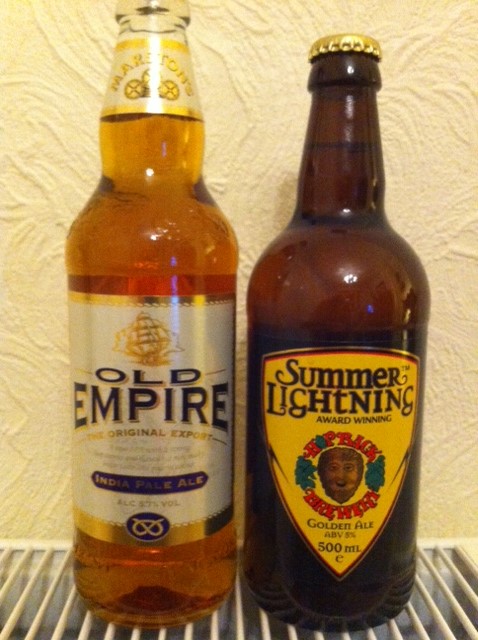
Marston's Old Empire is packaged in a clear bottle and looks attractive. Be careful of light strike but this beer is a good old fashioned English IPA. A clean refreshing bitterness with good but not over powering hop. It also has a good alcohol punch at 5.7% abv so a beer to respect. You don't often see it on draught but in bottle it's a gem.
Hopback Summer Lightning is a real favourite of mine. A classic beer and one of the first golden ales. It is a CAMRA prize winner and has managed to become an all year round beer rather than just a beer for the summer. The aroma is a grassy hop and hint of lemon. The taste is hop citrus, grassy and dry refreshing savoury finish, but not at all harsh. Hoppy yes, but not for hopheads.
St Austell Proper Job is a wonderful beer, packed full of citrus hop, lemon and pineapple, the Chinook hop gives a pine resinous character while the cascade compliments with a touch of spice. One of the first real hoppy English beers in the American style, its been overtaken by many imitators now in terms of hoppiness, however the bottle in particular is really well balanced drink. Plenty of bitterness without being completely unbalanced.
All three of these beers are great with the BBQ, far more interesting than a lager but just as satisfying. Do look for other IPA's though. If you like hops then go for the American style ones but for a real balanced beer that will not overpower your dinner, the English IPA's work best.
Instantly BBQ's are associated with a can of Fosters for refreshment, but just like the food we cook has moved on to become more adventurous, our choice of refreshment needs to change as well.
That's not to say there is anything wrong with a refreshing lager on a hot summers evening, but don't limit yourself to that when it comes to the choice of beer. So what beer's go best with a BBQ? Lighter golden beers seem to be the most appropriate as naturally we drink with our eyes so here are a few suggestions of great beers to enjoy. Somehow the heavier stouts and strong ales don't lend themselves to this, great beers that they are though!
| Old Empire & Summer Lightning |
Hopback Summer Lightning is a real favourite of mine. A classic beer and one of the first golden ales. It is a CAMRA prize winner and has managed to become an all year round beer rather than just a beer for the summer. The aroma is a grassy hop and hint of lemon. The taste is hop citrus, grassy and dry refreshing savoury finish, but not at all harsh. Hoppy yes, but not for hopheads.
St Austell Proper Job is a wonderful beer, packed full of citrus hop, lemon and pineapple, the Chinook hop gives a pine resinous character while the cascade compliments with a touch of spice. One of the first real hoppy English beers in the American style, its been overtaken by many imitators now in terms of hoppiness, however the bottle in particular is really well balanced drink. Plenty of bitterness without being completely unbalanced.
All three of these beers are great with the BBQ, far more interesting than a lager but just as satisfying. Do look for other IPA's though. If you like hops then go for the American style ones but for a real balanced beer that will not overpower your dinner, the English IPA's work best.
Sunday, 28 April 2013
Vale of the White Horse
These three beers all arrived for my birthday and excellent choices they were too. White Horse Brewery and West Berks Brewery are long established and robust micro brewers. Bellingers on the other hand are more recent and brew in the back of the family garage business of the same name.
West Berks Brewery are famous for Maggs Magnificent Mild, but this bottle of Goldstar was a super beer with old fashioned roast malt & burnt toffee with hints of honey and good bitterness, a fine beer indeed. Shame about the branding on the bottle, I certainly needed my glasses to appreciate that!
The White Horse Bitter at 5.1% had all the hall marks of a fine beer, with the branding on the bottle very striking and implied a confident and robust beer. It delivered in this respect being roast and malty with a hint of toffee, but perhaps the flavours were not as big as the Goldstar. None-the-less a good beer.
| Goldstar left, White Horse centre, Bellingers right |
My reason for featuring these is that some beers are instantly recognised as good and interesting because of the geographical area of origination. For example beers from Yorkshire and Cornwall are instantly thought of as good beers because of their county of origin. However the area of the country that cuts across Berkshire and Oxfordshire, which is known as the Vale of the White Horse, also has some fine brewers and their beers compare well with any from the fore-mentioned counties. Do try them if you get a chance.
Sunday, 31 March 2013
Cider & Ginger Beer
Everything seems to come full circle in the brewing and
brands world. Categories grow and then proliferate into other categories as
brand owners look for growth options. One example is cider.
Cider has enjoyed a tremendous last few years with the
Magners fuelled growth creating consumer interest and opportunities for other
cider makers. A number of quality ciders have emerged to the fore as well as
other ciders that are targeted at the 18 to 25 age category. The latter have taken sales from Premium
Packaged Spirit (PPS) brands such as Bacardi Breezer and WKD.
However, as more brands enter the market the traditional
cider has begun to take on the uniform of the PPS. Now, fruit ciders are all the rage and this is
where the growth is coming from. Flavour wise these are very close to the
fruity PPS brands we became so familiar with. It is basically that sweet fruity
flavour that younger people find quite accessible.
Another example is the ginger beer category. Perhaps initially
closer to a PPS in flavour anyway, the market leader here, Crabbies is about to
launch a Strawberry version. Consumers will doubtless show interest in this
with the power of the Crabbies brand behind it and we’ll soon see the traditional
PPS, fighting for the same crowded market place with a fruit cider and a fruit
beer!
So, although the PPS brand is in decline, it has been
replaced with a version of cider and possibly beer that is not too dissimilar
in flavour to its PPS counterpart. I wonder what’s next - perhaps the interest
in craft beer is the next category to find its way to the younger drinker?
Sunday, 24 March 2013
In praise of the Regional Brewer
Love them or
not, Regional Brewers have become beacons of hope for cask ale drinkers over
recent years. However they are not always popular with consumers being
associated with local monopolies, accused by some of having a stranglehold
over choice and price. Also the recent interest in craft beers has led to
Regionals being over shadowed for more fashionable, younger and exciting
brewers who are new to the market.
But let’s be
positive, cask ale drinkers have a lot to thank Regional Brewers for! They have
done a great job in maintaining and growing the cask ale market as
multi-national companies and national brewers have moved away from cask into
lager and cider. Often much maligned, Greene King have continually invested in
their cask brands and recently announced a £4 million investment in Old
Speckled Hen and Greene King IPA. Marston’s too have supported the sector with
their sponsorship of the England cricket team with Pedigree. In London, Fullers
with London Pride have done TV advertising with James May, whilst Wells &
Young’s have invested hugely for Bombardier.
What is often
overlooked is that as the bigger regionals invest in marketing their
brands, they also help to sustain and grow the whole cask sector. Fo example If someone is
encouraged by the advertising to switch from lager to Greene King IPA, they are
converted into a cask ale drinker which in turn may lead them to try many other
beers.
Regional
Brewers have also been very active in the campaign against the hated Beer duty
Escalator. The news this week that this is to be removed, plus and a further 1p
drop in beer duty, is a great credit to their sustained efforts over the past
few years.
Finally, let’s
not forget that Regional Brewers brew some fantastic beers, all of which are
produced to a consistently high standard. The word consistency is something
Regionals brands have become synonymous for. Micro’s and Craft Breweries (and I
don’t know the difference) brew some very tasty beers as well, but they are
perhaps less consistent. One week it’s wonderful but the following week it can
be less so. However the Regional brewer has the systems and equipment in place
to brew consistently good quality beer every week.
So in
conclusion, do be positive if you have a local Regional Brewer and support
their beers and pubs.
.
Sunday, 17 March 2013
Craft Beer Rising?
Craft Beer Rising?
It most certainly is. I attended the Craft Beer Rising Beer Festival in Shorditch, London recently. A great little beer festival with live music, it was very different to the usual CAMRA run event.
First of all there was no mass row upon row of cask beers or huge beer list with silly names for that matter. Brewers were invited to attend and each given the same size stand, so no matter if you were a super regional such as Greene King, or a small up and coming micro brewer such as Rebel Brewing Co, brewers were pitched equally alongside each other.
The next most noticable thing was the age group of the general public. I've attended my share of CAMRA events in the past and they tend to attract people like me.....older, experienced ale drinkers and mostly males. CBR was totally different, fresh younger faces were there of both genders, all eager to try the new craft beers and some of the old favourites on offer.
For attracting younger people CBR should be applauded. Yes, the organisation could be improved and I'm sure a few things will change next year, but for me the most important thing was that for once, new drinkers were being attracted to the category.
So what was the catalyst for this? As good as the beer festival was with the music it played, I believe it's the "C" word that attracts younger people - Craft beer is cutting edge, its fashionable for younger people, just as the term "Real Ale" was fashionable when I was younger. The definition of craft beer is not yet clearly defined and perhaps one day the brewing industry will set about this, but for the moment, if craft beer means beer for younger people then I'm all for it.
It most certainly is. I attended the Craft Beer Rising Beer Festival in Shorditch, London recently. A great little beer festival with live music, it was very different to the usual CAMRA run event.
First of all there was no mass row upon row of cask beers or huge beer list with silly names for that matter. Brewers were invited to attend and each given the same size stand, so no matter if you were a super regional such as Greene King, or a small up and coming micro brewer such as Rebel Brewing Co, brewers were pitched equally alongside each other.
The next most noticable thing was the age group of the general public. I've attended my share of CAMRA events in the past and they tend to attract people like me.....older, experienced ale drinkers and mostly males. CBR was totally different, fresh younger faces were there of both genders, all eager to try the new craft beers and some of the old favourites on offer.
For attracting younger people CBR should be applauded. Yes, the organisation could be improved and I'm sure a few things will change next year, but for me the most important thing was that for once, new drinkers were being attracted to the category.
So what was the catalyst for this? As good as the beer festival was with the music it played, I believe it's the "C" word that attracts younger people - Craft beer is cutting edge, its fashionable for younger people, just as the term "Real Ale" was fashionable when I was younger. The definition of craft beer is not yet clearly defined and perhaps one day the brewing industry will set about this, but for the moment, if craft beer means beer for younger people then I'm all for it.
Subscribe to:
Comments (Atom)